ForgeTax Guide — Complete Walkthrough: Odds, Sword Value, Relics & Tribute
The complete ForgeTax guide on one page: the core loop, +0 forging odds table, sword value formula, relic ticket mechanics, Dragon Tribute prep, and stop-loss rules, with links to every deep-dive guide.
This ForgeTax guide collects the decision rules that matter into one page. ForgeTax is a dark first-person forging roguelite with no combat, and the whole game reduces to a single question: does this strike earn more than it risks losing? This page answers that question with the probability data, the sword value formula, the relic principle, and the tribute prep order — then links every deep-dive topic to its dedicated guide.
The ForgeTax Guide at a Glance
| Question | Short answer |
|---|---|
| What is the goal? | Forge valuable swords, convert surplus into relics, and pay the Dragon Tribute before the deadline |
| Is there combat? | No. ForgeTax is pure risk management around the anvil |
| How much is it? | $2.99 on Steam. Check the Steam page for current regional pricing |
| What is the safest phase? | +0 through low levels. A +0 sword cannot break on a single strike |
| First priority? | Set a stop threshold and reserve a tribute-qualifying blade early |
The Core Loop — Furnace to Tribute
Every run uses the same loop: heat the sword in the furnace, place it on the anvil, strike to raise value, then compare the grown risk against the remaining upside after every strike. That repeated judgment is the game. Your first run should aim to learn the risk curve, not to chase a record number. The step-by-step first run lives in the ForgeTax beginner guide.
Forging Odds — the +0 Distribution
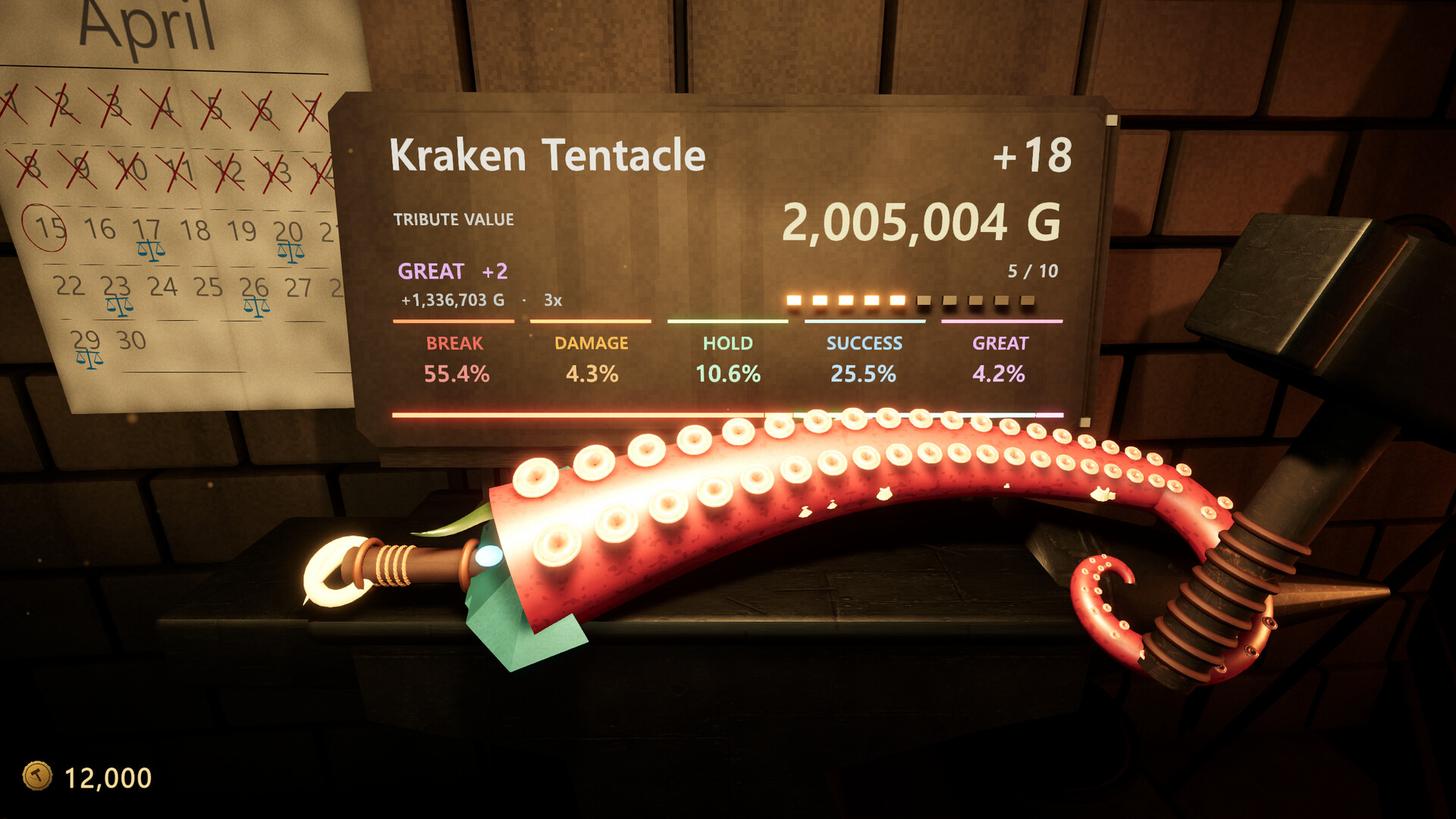
A community simulator built from the game's code (Steam build 25755699) records this strike distribution for a fresh +0 sword:
| Result | Probability |
|---|---|
| Success | 64.0% |
| Great | 8.0% |
| Hold | 20.0% |
| Damage | 8.0% |
| Break | 0.0% |
Because a +0 blade cannot break on a single strike, early strikes are the safest source of value. As grades rise, break tickets grow inside the deck, and the on-screen percentages become the practical source of truth. The full tables and the fairness dispute are covered in ForgeTax forging odds, and strike-by-strike judgment in ForgeTax strike timing.
Sword Value Formula — the Baseline for Every Decision
| Rule | Effect |
|---|---|
| Base sword | 320 G |
| Each enhancement level | ×1.5 |
| Great strike | ×2.5 |
| Ghost Merchant lines (World Tree / Fish Blade / Funeral Sword) | ×2 an equivalent normal sword |
For example, a +10 normal sword with no Great strikes is worth 320 × 1.5^10 ≈ 18,400 G, and each Great multiplies that by 2.5. Knowing the formula turns "is this strike worth it?" into arithmetic instead of instinct. To price the next Great at your current level, use the ForgeTax Forge Probability Calculator; the selling, tribute, and relic-side reading of value continues in ForgeTax sword value.
Relics — Ticket Dilution Is the Whole Principle
Each enhancement grade is modeled as a 1,000-ticket deck. Relics that add Success or Great tickets do more than raise the ceiling: they dilute the share of break and damage tickets in the deck. That is why ticket-adding relics sit at the top of community tier lists — they improve upside and survival at the same time. Effect and cost tables are in ForgeTax relics, machine operation in ForgeTax relic machine, and combination priorities in ForgeTax relic synergy.
Dragon Tribute — the Deadline Decides the Run
The tribute deadline is the progression requirement of every run. The practical priority is simple: secure a blade that already qualifies before deadline pressure starts, and never strike that blade again. How tribute demands scale is covered in ForgeTax dragon tribute and ForgeTax dragon mechanics, with run-wide planning in ForgeTax tribute planning.
Stop-Loss Rules and the Three Play Styles
- Conservative: low targets, early lock-ins. Best for your first sessions.
- Balanced: strike in milestones and re-evaluate after every hit. The default posture.
- Aggressive: high targets and Frenzy-window sprints. Only after stop-loss is automatic.
All three share one rule: when the next strike can lose more than it can earn, stop. The Frenzy window is covered in the ForgeTax Frenzy guide, resource flow in ForgeTax resource management and ForgeTax materials.
ForgeTax Guide FAQ
Is ForgeTax hard to learn?
The controls are simple, but the decisions are not. Learn the forge first, then treat every strike as a risk-versus-reward choice rather than an automatic upgrade.
What are the ForgeTax forging odds at +0?
A fresh +0 sword records 64% Success, 8% Great, 20% Hold, 8% Damage, and 0% Break. In-game displayed odds remain the live source of truth.
How is ForgeTax sword value calculated?
A base sword is worth 320 gold, each normal level multiplies value by 1.5, a Great strike applies 2.5x, and Ghost Merchant lines are worth twice an equivalent normal sword.
Are there active ForgeTax codes?
No redeem codes have been found so far. The codes page will be updated if that changes.
How do I stop breaking ForgeTax swords?
Read break chance before every strike, use ticket relics to dilute negative outcomes, stop once a blade qualifies for tribute, and bank value instead of chasing one more hit.
Every ForgeTax Guide in One Place
- Forging: forging odds · strike timing · sword forging
- Swords: sword value · sword upgrades · sword evolution
- Relics: relics · relic machine · relic synergy · best relic builds
- Tribute: dragon tribute · dragon mechanics · tribute planning
- More: beginner guide · download · Frenzy · achievements · materials · resource management · codes
- Tool: Forge Probability Calculator
Related Guides
ForgeTax Achievements: All 19 Achievements & Relic Unlocks
Complete ForgeTax achievements list: all 19 achievements with exact requirements, the 16 relics they unlock, completion order, and milestone tracking for 100% completion.
ForgeTax Beginner Guide: Steam, First Run, Systems & Survival
A complete ForgeTax beginner guide for the Steam version: safe download and trial info, forging basics, break risk, relics, Frenzy, Dragon Tribute, and first-run survival steps.
ForgeTax Controls: Actions, Frenzy & Safe Input Guide
A practical ForgeTax controls guide: the core forge actions, Frenzy activation, mouse precision, stop rules, and what the official store confirms about PC input.
ForgeTax Damage Build: Relics, Progression & Tribute Planning
Learn how a ForgeTax damage build works: relic direction, break control, level recovery, and when to stop pushing damage and protect tribute blades.