ForgeTax Forging Odds: Strike Results & Break Chance
ForgeTax forging odds explained: the Success/Great/Hold/Damage/Break rolls, the 1,000-ticket deck, the +0 probability table, and the disputed fairness.
ForgeTax forging odds decide everything that happens on the anvil. Every hammer strike draws one result from five — Success, Great, Hold, Damage, or Break — and knowing how those rolls are built is what separates planned forging from gambling. This page collects the probability data extracted from the game's code, the deck mechanic behind it, and the fairness dispute that dominates the game's negative reviews.
The Five Strike Results
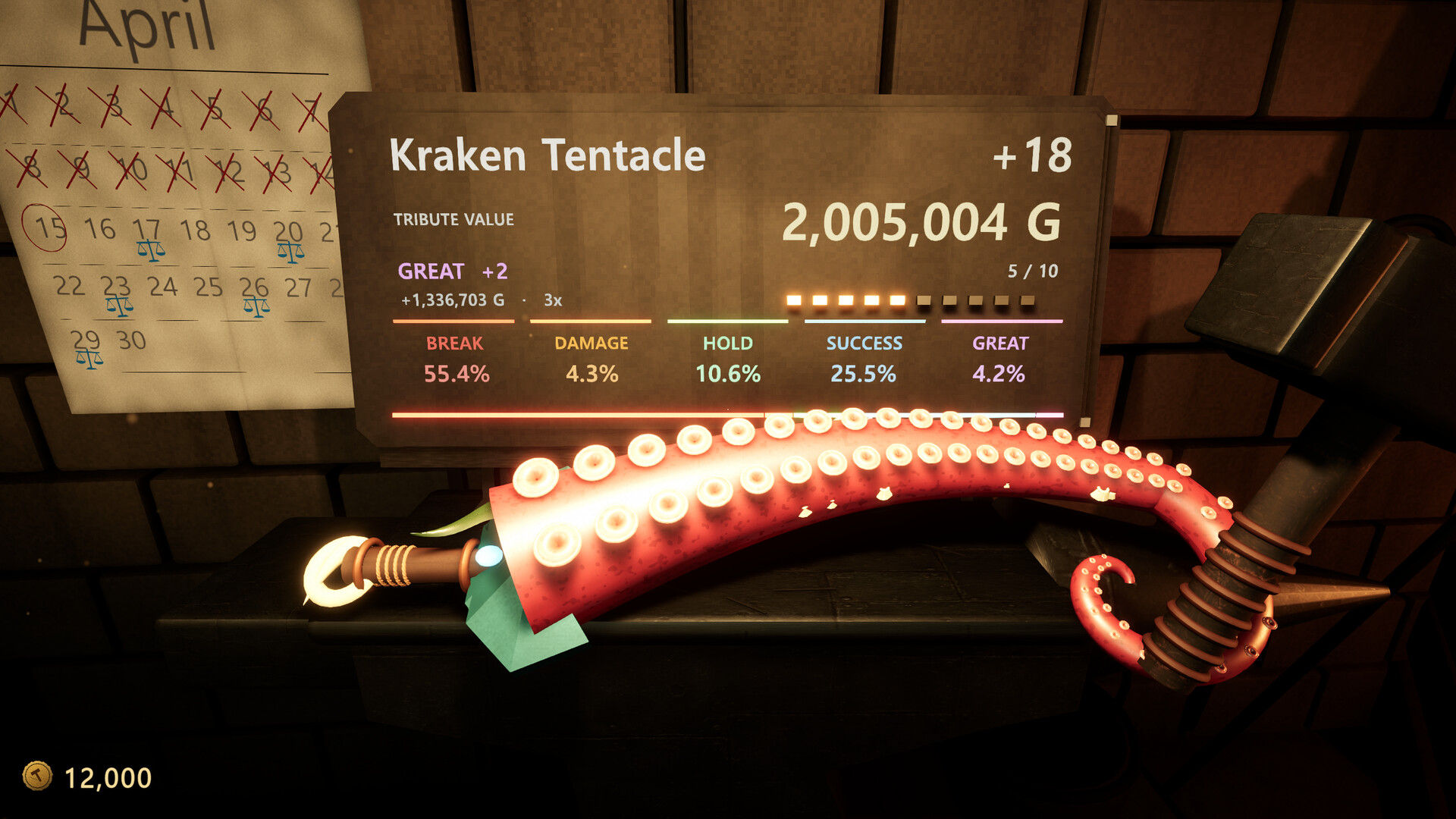
Each strike rolls exactly one outcome:
- Success raises the sword's level and value.
- Great is a stronger success with a larger value jump — a Great forge multiplies the blade's value by 2.5×.
- Hold gains nothing and loses nothing.
- Damage knocks levels or value off the blade.
- Break shatters the blade entirely; all enhancement is lost.
The Forge simulator built from the game files (Steam build 25755699) records the following distribution for a fresh +0 sword:
| Result | Probability |
|---|---|
| Break | 0.0% |
| Damage | 8.0% |
| Hold | 20.0% |
| Success | 64.0% |
| Great | 8.0% |
A +0 blade literally cannot break on a single strike — which is why early strikes are the safest value in the game.
The 1,000-Ticket Deck Mechanic
Under the hood, each enhancement grade is modeled as a deck of 1,000 tickets. A strike draws a ticket; the ticket determines the result. As the grade rises, the deck's composition shifts and break tickets increase — which is why displayed break chance climbs with every level.
The important consequence: relics that add tickets do double duty. Adding Success or Great tickets dilutes the break share of the deck, so ticket-adding relics simultaneously improve your upside and cut your break chance. This is why ticket relics sit at the top of most community tier lists.
How the Odds Move as You Forge
Recorded in-game samples from players show the spread at higher grades: Success rates observed between roughly 37% and 57%, and break chances anywhere from 1.4% up past 40% on deep enhancements. One Korean streamer's +0 first strike showed a 57% Success rate; the same session later displayed 30% break chances that drew loud complaints.
Exact per-level tables beyond +0 vary with relics, tickets, and patches, so the displayed percentage on your screen remains the practical source of truth. What stays constant is the shape: risk starts near zero, climbs with every strike, and eventually grows faster than value.
The Fairness Controversy — Both Sides
ForgeTax's "Mixed" review status is driven largely by one dispute: whether the displayed percentages are honest.
Players report blades shattering on their first strike at a displayed 3.8% break chance, or repeatedly at sub-5% odds. One refund-window player claimed the 10–20% band actually combines destruction and damage rather than pure break chance. Others argue break odds above 25% behave like a near-guarantee in practice.
On the other side, defenders — including the Polish review that examined the system closely — argue the visible risk display is a strength: even at long odds you always know exactly what you are betting. The community data team's simulator claims line-for-line parity with the game code, which suggests the dispute is about variance perception as much as implementation. Both positions are recorded here as-is; there is no confirmed verdict.
Using Odds in Real Decisions
Odds are decision inputs, not fate. The practical applications:
- Front-load value: strikes at low grades are nearly risk-free; take them freely.
- Read the display before every strike: when break chance approaches your stop threshold, that is the signal, whatever the theory says.
- Dilute the deck: ticket relics shift the distribution before you swing.
- Respect the checkpoint rule: re-evaluate after every success rather than riding a hot streak.
Key Takeaways
The +0 table (64/8/20/8/0) is the one firm anchor every player should memorize. Everything above +0 shifts with grades, relics, and patches — displayed odds are the live truth. And the fairness debate, unresolved as it is, teaches the right lesson anyway: variance is real, so your stop-loss rules must be real too.
Related Guides
ForgeTax Strike Timing: When to Stop & Stop-Loss Rules
ForgeTax strike timing guide: stop-loss conditions, the strike decision framework, the 50/50 checkpoint rule, and how to bank blades before risk wins.
ForgeTax Sword Forging: Strike Strategy & Risk Guide
ForgeTax sword forging explained: heat, strike, and stop — how every hammer strike changes blade value and break risk, plus the five-step decision process.